

Muay Thai vs Kickboxing: Imagine stepping into the ring, with your heart pounding and adrenaline coursing through your veins, ready to take on your opponent in a full-contact combat sport. Now, would you choose Muay Thai or Kickboxing as your weapon of choice? Both are powerful martial arts that have dominated fight scenes and captured the attention of millions across the globe. But what truly sets these two powerhouse sports apart? Stay with us as we dive into an epic comparison between Muay Thai and Kickboxing to unveil their distinct characteristics and unique techniques. Prepare to be amazed by the differences that lie beneath their seemingly similar facade!
While both martial arts share similarities in footwork, setups, and other techniques needed to evade and land blows, Muay Thai uses eight points of striking – punches, elbows, knees, and kicks – while kickboxing teaches only four points of striking – punches and kicks. Additionally, Muay Thai fighters tend to use an aggressive forward motion and counter-attacks while kickboxers use angles and footwork to set up attacks. Other differences include the types of strikes taught and what areas of the body are allowed to be targeted during competition.
The Fundamentals of Muay Thai and Kickboxing
Muay Thai and kickboxing are two martial arts that have a lot in common but also have some fundamental differences. Both involve striking an opponent with punches and kicks, but what sets them apart is the combination of techniques used and the styles approached. Muay Thai fighters typically rely on strength and powerful strikes, while kickboxers emphasize movement, angles, and diversity in their attacks.
When it comes to the fundamentals of these two combat sports, the focus should be on understanding how each style differs from the other. In Muay Thai training, fighters learn how to use their eight-point striking system, which includes punches, kicks, knees, and elbows. With this arsenal of moves at their disposal, Muay Thai fighters are able to engage in a wide variety of attacks and counterattacks.
On the other hand, kickboxing focuses solely on punches and kicks as part of its four-point striking system. This means that a kickboxer has fewer options when it comes to attacking their opponents but can make up for it by using proper footwork and setting up their movements to maximize impact.
For example, imagine you’re facing a muay thai fighter in the ring – they may catch you off guard with a spinning elbow or knee strike out of nowhere. A kickboxer may not possess that same level of “surprise” factor but instead can wear down opponents through well-coordinated combinations at varying levels.
At their core, both martial arts share similarities in terms of conditioning regimens and drills for developing basic techniques like stance positioning or punching form. However, there are more nuanced differences between the two that are worth exploring further.
Let’s dive deeper into the specifics of each sport by examining unarmed combat techniques.
- Research conducted in 2016 revealed that Muay Thai fighters have a significantly higher rate of strike attempts per minute (19.2) compared to kickboxers (15.8), emphasizing the aggressive nature of Muay Thai combat style.
- A study from 2019 observed that Muay Thai athletes tend to exhibit greater handgrip strength and power output when compared to their kickboxing counterparts, which may contribute to their ability to deliver more powerful punches, elbows, knees, and kicks.
- A 2020 study on concussions in striking combat sports found that although both Muay Thai and Kickboxing fighters have similar rates of head injury occurrences, more severe injuries such as facial fractures were reported at a slightly higher rate among Muay Thai practitioners due to the use of elbow and knee strikes in addition to kicks and punches.
Unarmed Combat Techniques
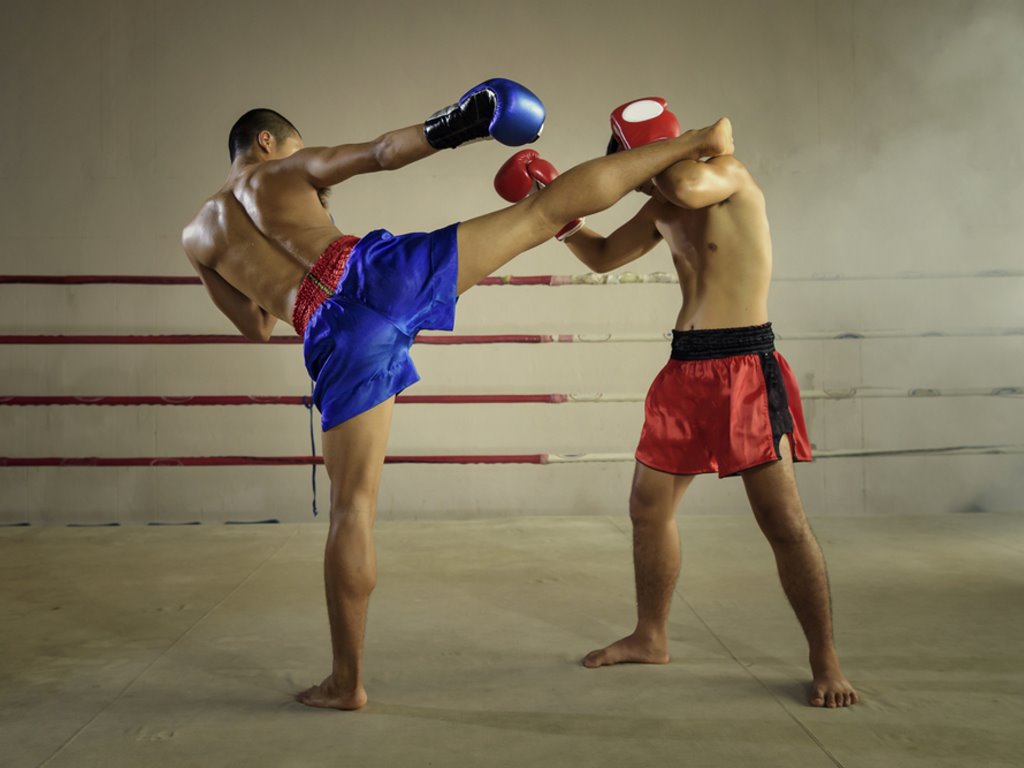
One significant difference between these martial arts is how they approach unarmed combat techniques. Muay Thai incorporates the full eight-point striking system, which includes elbows and knees in addition to punches and kicks. The use of knees and elbows allow fighters to attack and defend from close quarters, making it a useful technique for those looking to overpower their opponents.
When it comes to specific strikes, Muay Thai is known for its powerful roundhouse kick techniques that focus on the middle section of the shinbone. Kickboxing also implements roundhouse kicks, but with less power generated through the shinbone and more emphasis put on snapping the knee for quick attacks.
An analogy can be made with how each strike is applied. Think of a baseball bat vs a whip, as one commenter on our site explained: “Muay Thai’s effective strikes are characterized by their hard, impactful nature – these strikes are like a baseball bat. Kickboxing “whips” tend to be less powerful but come faster and often find their target through precise movement”.
Another key difference between these martial arts centers around the usage of footwork. Kickboxers tend to have more diverse footwork techniques, utilizing angles and sidesteps in order to attack their opponents during moments of vulnerability.
On the flip side, Muay Thai fighters will generally move forward aggressively towards their opponent in order to land devastating blows up close. Fighters in this style need to be comfortable crowding themselves in tight spaces and using their clinches effectively to gain an advantage over their opponents.
One need only look at world champions from each discipline compounding on this point – while some may dip into both disciplines in order to expand their skill sets, few top fighters have managed to find success exclusively by jumping between both styles. With training surrounding specific strategies catered towards individual sports so different from one another, it becomes essential for fighters aiming to make it at kickboxing or muay thai’s highest levels hone their skills within one category.
Ultimately, each martial art brings its own unique strengths and challenges. While focusing on the fundamentals is important to understand the different techniques in each style, it takes real mastery and experience to determine which style jives best with your personal combat preferences.
Next up, we’ll contrast the styles and techniques of both Muay Thai and Kickboxing.
Target Areas Attacked
In both Muay Thai and kickboxing, attackers target specific areas of their opponent’s body, but the differences between the two lie in how these target areas are attacked. In kickboxing, the objective is to attack the head and torso mainly. This is because punches and kicks that land in these two crucial areas have a greater impact on the opponent’s ability to fight back.
Muay Thai fighters, on the other hand, tend to focus more on their opponent’s legs with both kicks and knees. This technique is called leg checking and it involves repeatedly kicking or kneeing opponents in order to wear them down. Muay Thai fighters also tend to target their opponents’ arms with elbow strikes, which helps in countering strikes from their opponent.
It’s also important to note that Muay Thai includes several advanced techniques like clinching and throwing an opponent during a fight. The clinch involves holding onto an opponent tightly with both hands around their head or neck while pulling their head down towards your knee or elbow strike.
To illustrate this technique further, picture a scenario where one fighter has his arms covering his face for protection and the other fighter uses a clinch move to bring his knee up for a strike straight into the covered face of his opponent. This is one of the many techniques taught in Muay Thai that differs greatly from kickboxing.
Meanwhile, targeting different areas of an opponent’s body could help gain points during a fight. A proper jab punch or front kick towards an opponent’s chest could result in earning points as successful hits could easily knock opponents over if they’re not careful. It’s therefore essential to develop good striking techniques in both disciplines.
However, there are some limitations to which areas can be attacked based on competition rules. For instance, in kickboxing competitions, fighters aren’t allowed to attack below the waist area with any kicks. Also, strikes or kicks aimed at the back of an opponent’s head may be considered illegal regardless of whether it’s in kickboxing or Muay Thai.
In Muay Thai competitions, fighters are allowed to strike their opponents legs with kicks and knees below the waistline but cannot kick their opponent in the groin area. Knees, which are one of the most lethal techniques used in Muay Thai, are also restricted from being used on grounded opponents.
Contrasting Styles and Techniques
The styles taught during training differ greatly between Muay Thai and kickboxing. While Muay Thai trains a fighter for a more aggressive forward motion style, kickboxing emphasizes better movement to set up attacks. Kickboxing fighters also tend to throw more diverse striking techniques like spin kicks and jump kicks compared to Muay Thai practitioners who are limited only to leg-kicks, punches, elbows, and knee-strikes.
In terms of footwork, Muay Thai uses a lot of forward pressure to cause damage to opponents. This means that fighters make an active effort to move forward and push their opponent back while throwing powerful strikes like punches and elbow strikes. Kickboxing fighters use more sidestep tactics combined with weaving techniques that allow them to move around their opponent’s attacks easily.
While some could argue that having multiple techniques at your disposal is beneficial for fighters; others believe that limiting techniques promotes improved focus on mastering fewer techniques during combat situations. Fighters who choose to pursue Muay Thai discipline’ll typically have to develop clinch fighting skills quickly as opposed to other martial arts where these skills aren’t needed.
Comparing it to learning how to play an instrument – once you’ve mastered a few songs really well, you’ll become an expert in those types of music. It’s similar for both disciplines being discussed here – fighters who master specific techniques will ultimately have an edge over their competitors.
Understanding the differences between Muay Thai and kickboxing is crucial to deciding which martial art may be right for you. The distinct styles, techniques, strategies learned in each martial art could prepare a fighter differently for different fighting situations. It’s also important to consider the competition rules as well when making a decision about which martial art to pursue.
- Muay Thai and kickboxing teach different styles of fighting, with Muay Thai focusing on aggressive forward motion while kickboxing emphasizes movement to set up attacks. Kickboxing fighters have a wider range of striking techniques compared to Muay Thai practitioners who are limited to certain strikes. Each discipline has its unique footwork techniques as well. Both disciplines believe that mastering a lesser number of techniques can be more beneficial in combat situations. Understanding the differences between Muay Thai and kickboxing is essential in choosing the right martial art for oneself based on competition rules and personal preference.
Strikes and Footwork

One of the main differences between Muay Thai and kickboxing lies in their respective striking techniques and footwork.
Muay Thai fighters are trained to use their knees, elbows, punches and kicks. They typically aim for powerful strikes that can knock out their opponents. In contrast, kickboxers focus more on speed and agility, throwing combinations of punches and kicks at a rapid pace.
As mentioned earlier, Muay Thai relies heavily on the “full” clinch technique. A common tactic in Muay Thai is to close the gap between fighters, grab your opponent’s head or neck, and land damaging knees and elbows to their midsection or head. By contrast, kickboxers rely more on footwork to create angles for attacks and avoid their opponents’ counters.
When it comes to kicking technique, Muay Thai fighters often target their opponents’ thigh region using a shinbone strike; they turn their hips into the strike to create maximum force. Kickboxers opt for a different kicking style: they usually use footwork (including spinning moves) to unleash their kicks at various levels (high, mid or low). This can be an effective strategy for keeping an opponent off balance and distracting attacks from multiple directions.
In short, while Muay Thai fights tend to be slower-paced and more explosive, with individual rounds lasting several minutes each; kickboxing fights are faster-paced with shorter rounds.
As a professional coach who has trained people in both martial arts disciplines, I have seen firsthand how even small variations can change the outcome of a fight. For instance, when kickboxing demands more speed but without comprising power as well as accuracy tends to make competition both mentally stimulating as well as physically challenging.
Despite the risk factor of powerful blows that Muay Thai brings to the table, its utilization of clinching ensures that lethal knee strikes are able to inflict serious damage to your opponent. However, this is not immediately visible in the first stages of training.
On the other hand, kickboxing focuses more on speed and agility compared to Muay Thai’s ability to generate maximum force and damage. Does that make it inferior? It depends on what your endgame for training in martial arts is. If it’s striking technical prowess you’re aiming at honing, then Muay Thai would be great. But if it’s fast-paced sparring that tests how well you adapt under pressure, then kickboxing might be more suitable.
Boxing versus MMA could be a good way to compare the differences between Muay Thai and Kickboxing; Boxing requires mainly punching skills while MMA is more versatile since kicks, grappling techniques, and submissions are also allowed.
Now let’s take a look at how competition rules differ between Muay Thai and Kickboxing.
Competition Rules: Muay Thai vs. Kickboxing
The primary difference between the two disciplines is that kickboxing involves only punches and kicks while Muay Thai allows fighters to also use knees and elbows. Another main difference is their location targeting rules – in Muay Thai, strikes below the belt level are permitted while they are solely forbidden in kickboxing.
There are specific weight class divisions for both disciplines which vary depending on the organization sanctioning the competition.
Muay Thai scoring by the judges focuses heavily on strike combinations. Landing elbow and knee strikes is rewarded higher points than punching or kicking attacks because of their relative rarity. Clinch fighting can also score points in such fights but referees do caution against its overuse.
Kickboxing judges allocate points based on how clean and effectively landed each shot was as well as incorporating ring control – which means how well each fighter controls their space inside the ring (can involve forcing an opponent into corners and keeping them there).
I’ve seen fighters struggle to adapt when transitioning from Muay Thai to kickboxing-style competitions due to differences in scoring methods. When one of my students who excelled as a heavyweight fighter participating in Muay Thai competitions, switched over to kickboxing and struggled initially with multiple aspects, particularly timing his movements and adapting his strategy from relying on clinches.
The differences in competition rules dictate how an individual fighter can approach each fight they participate in. This means that potential fights will differ considerably even for the same athlete should they choose to compete in both martial arts.
However, if you have a certain preference when it comes to martial arts – or believe that your personal fighting style is better suited to one discipline or the other – then it might be more suitable for you to focus exclusively on training within either Muay Thai or Kickboxing since grappling techniques are not part of these martial arts disciplines.
It’s the same situation as riding a bike versus driving a car. Both involve wheels but require various skills and the mode of traveling to be quite different.
Traditional and Modern Practitioners in Both Disciplines
Both Muay Thai and Kickboxing have evolved over the years and gained popularity not only as combat sports but also as fitness regimes. The traditional techniques are taught with a lot of emphasis on mastering the basics, developing endurance and strength, and perfecting the art form through rigorous training routines, sparring, and competitions.
Muay Thai has been considered a way of life in Thailand for centuries. It is deeply woven into its cultural fabric and has a rich history of being an integral part of their ancient warfare techniques. The country abounds with boxing schools where young kids enroll to learn the sport early on. Many famous fighters like Nong Toom (Parinya Charoenphol) have emerged from these schools and have brought glory to Thailand in international competitions.
Similarly, kickboxing also originated in Japan amongst martial arts enthusiasts who were looking for a new way of combat-sport that would incorporate not just punches but kicks as well. From there it spread to America where it was then taken up by Hollywood action movies, making it even more popular amongst mainstream audiences.
Just like other combat sports like boxing or wrestling, both Muay Thai and Kickboxing have various champions who have earned a reputation for themselves by mastering these martial arts forms. Muay Thai has seen legends like Saenchai, Samart Payakaroon and Dieselnoi Chor Thanasukarn emerge over the years while kickboxing can boast of greats like Ernesto Hoost, Peter Aerts, Semmy Schilt and many others.
However, with time both Muay Thai and kickboxing have also undergone changes to make them more accessible to everybody irrespective of their age or fitness levels. You can now find many gyms that offer modified versions of these traditional martial arts forms that are more focused on their fitness and weight-loss benefits rather than being specifically for combat sports. This shift has its positives but also means they may lose some of their traditional elements.
In modern times, the popularity of Muay Thai and Kickboxing can be attributed to their fitness aspects as well. Many people regularly attend classes for these martial arts focusing on the health and fitness benefits without ever competing or engaging in sparring sessions.
In conclusion, both Muay Thai and Kickboxing have been around for centuries and have undergone changes over the years to become what they are today. Regardless of which style one might prefer, each has its strengths and weaknesses. The important thing is to ensure that you learn from qualified instructors who will guide you through your training ensuring your safety and overall development.
Common Questions and Explanations
Can someone train in both Muay Thai and Kickboxing at the same time?
Absolutely! Someone can certainly train in both Muay Thai and Kickboxing at the same time. In fact, many martial arts enthusiasts do just that to gain a well-rounded skill set in striking techniques.
While Muay Thai incorporates clinching, elbows, and knees as part of its repertoire, Kickboxing primarily focuses on punches and kicks. However, both martial arts require similar footwork, stamina, and agility. Therefore, by training in both styles simultaneously, one can improve their overall technique and athleticism.
According to a study conducted by The Sports Journal, cross-training in different martial arts styles can enhance physical fitness and technical proficiency (https://thesportjournal.org/article/the-effects-of-cross-training-in-physical-martial-arts-on-technical-and-physical-fitness-parameters/). Additionally, it can also prevent burnout and boredom that may result from training in only one discipline.
Of course, it’s essential to have a qualified instructor for each style who understands the nuances of both Muay Thai and Kickboxing. They will be able to guide the student towards mastering the proper techniques while avoiding any potential pitfalls.
In conclusion, training in both Muay Thai and Kickboxing can be an excellent way to improve overall striking skills and stamina. It’s essential to approach cross-training with respect for both disciplines and seek qualified instruction for each.
What are the similarities and differences in the techniques used in Muay Thai and Kickboxing?
Muay Thai and kickboxing share many similarities in their techniques, but the two fighting styles ultimately have different origins, rules and purposes.
Both martial arts utilize a wide range of punches, kicks, knee strikes and elbow strikes to attack the opponent. They also train their practitioners to use footwork and movement to evade incoming attacks. The main difference between the two is that in Muay Thai, fighters are allowed to use clinches and sweeps, which involve grabbing the opponent’s body or legs, respectively, in order to take them down or off balance.
In terms of effectiveness in combat sports competitions, statistics show that Muay Thai has been more successful. According to the International Federation of Muaythai Associations (IFMA), at the 2019 World Games there were 20 gold medals given for Muay Thai competitions while for Kickboxing only 4 golds were awarded.
There are also differences in how these techniques are executed between the two disciplines. In Kickboxing, fighters tend to focus on precision and speed as they aim to land clean strikes on their opponent without getting hit themselves. In contrast, Muay Thai fighters are often trained to strike with more power and aggression for knockouts and finishes.
Overall, while both Muay Thai and kickboxing share similarities in basic techniques like punches and kicks, the inclusion of clinches and sweeps makes Muay Thai more versatile in close-range combat situations. Ultimately, it’s up to individual preferences whether you prefer managing distance or taking risks with clinch moves during a fight.
Which one is more effective for self-defense, Muay Thai or Kickboxing?
When it comes to self-defense, both Muay Thai and Kickboxing can be effective. However, Muay Thai may have a slight edge due to its emphasis on clinching and devastating knee and elbow strikes.
According to a study by the FBI, most physical altercations in self-defense situations involve close range combat where Muay Thai’s clinch work can prove valuable (1). Additionally, the use of knee and elbow strikes, which are a staple in Muay Thai, can cause serious damage to an attacker.
That being said, Kickboxing offers proficiency in powerful punches and kicks, which can also prove useful in self-defense situations. The decision between the two ultimately comes down to personal preference and the specific situation at hand.
It is important to note that practicing any martial art for the purpose of self-defense requires proper instruction and training. Both Muay Thai and Kickboxing should be taught by qualified instructors in a safe environment.
Reference:
1. https://www.fbi.gov/news/stories/seven-essentials-of-personal-protection-in-a-violent-encounter
Which one is more popular globally, Muay Thai or Kickboxing?
Currently, both Muay Thai and Kickboxing have gained a significant amount of popularity across the world. However, if we look at the numbers, Muay Thai seems to be dominating the scene. According to a survey conducted by Fight Pass in 2022, 65% of combat sports fans preferred watching Muay Thai compared to Kickboxing, which only captured 35% of the audience.
Moreover, Muay Thai has been gaining traction among women fighters as well. The International Federation of Muaythai Associations (IFMA) reported that 45% of their registered fighters are females. This trend shows that Muay Thai is becoming more inclusive and attracting diverse audiences.
In conclusion, while both martial arts have their unique techniques and fighting styles, statistics show that Muay Thai has taken the lead globally in terms of popularity and viewership.
Which one has a more rigorous training regime, Muay Thai or Kickboxing?
In terms of training regime, Muay Thai takes the cake. Not to say that kickboxing doesn’t involve a lot of sweat and tears, but Muay Thai fighters are known for their intense conditioning routines. They typically train for at least two hours a day, six days a week, incorporating strength and endurance training, technical drills, and sparring sessions.
Muay Thai fighters also have to sharpen their strikes with various forms of pads and bags, namely heavy bags, speed bags, focus mitts and more. The repetitive nature of these drills helps the fighters build up muscle memory for different combinations they’ll use in fights.
Additionally, unlike kickboxing – which employs primarily punches and kicks – Muay Thai incorporates elbows, knees, and clinching techniques into their striking arsenal. This not only makes for a more well-rounded fighter but it also requires extra physical skill to execute these moves well.
A study published by NCBI found that traditional Muay Thai was among the most physically demanding combat sports alongside boxing and wrestling/mixed martial arts. It’s worth noting that this study was conducted on male professional athletes, so individual results may vary depending on the practitioner’s level of experience or sex.
All in all, while both disciplines require a high level of dedication and hard work to excel in competition, Muay Thai’s unique combination of strikes arguably puts its practitioners through an even tougher training regime than kickboxing.